
Tourist places in Mandu, Madhya Pradesh
Mandu or Mandavgad is an ancient city in the present-day Mandav area of the Dhar district. It is located in the Malwa and Nimar region of western Madhya Pradesh, India, at 35 km from Dhar city. In the 11th century, Mandu was the sub division of the Tarangagadh or Taranga kingdom. This fortress town on a rocky outcrop about 100 km (62 mi) from Indore is celebrated for its architecture.An inscription discovered from Talanpur (around 100 km from Mandu) states that a merchant named Chandra Simha installed a statue in a temple of Parshvanatha located in the Mandapa Durg. While “Durg” means “Fort”, the word “Mandu” is a Prakrit corruption of “mandapa”, meaning “hall, temple”. The inscription is dated 612 VS (555 CE), which indicates that Mandu was a flourishing town in 6th century.
Mandu gained prominence in 10th and 11th century under the Paramaras. The town of Mandu, situated at an elevation of 633 metres (2,079 feet), is perched on the Vindhya Range extending for 13 km (8.1 mi) while overlooking the plateau of Malwa to the north and the valley of the Narmada River to the south which acted as natural defences for the fort-capital the Paramaras. As “Mandapa-Durga”, Mandu is mentioned as the royal residence in the inscriptions of the Paramara kings starting from Jayavarman II. It is possible that Jayavarman or his predecessor Jaitugi moved from the traditional Paramara capital Dhara to Mandu, because of attacks from the neighbouring kingdoms. Balban, the general of the Delhi’s Sultan Nasir-ud-din, had reached the northern frontier of the Paramara territory by this time. Around the same time, the Paramaras also faced attacks from the Yadava emperor Krishna of Devgiri and the Vaghela king Visaladeva of Gujarat. Compared to Dhara, which is located in the plains, the hilly area of Mandu would have offered a better defensive position.
In 1305, the Muslim Sultan of Delhi Alauddin Khalji captured Malwa, the Paramara territory. Ayn al-Mulk Multani, the newly appointed Governor of Malwa, was sent to expel the Paramara king Mahalakadeva from Mandu and cleanse that place from “the odour of infidelity”. With the help of a spy, Multani’s forces found a way to enter the fort secretly. Mahalakadeva was killed while attempting to flee, on 24 November 1305.[5][non-primary source needed]
When Timur captured Delhi in 1401, the Afghan Dilawar Khan, governor of Malwa, set up his own little kingdom and the Ghuri dynasty was established[unreliable source?] His son, Hoshang Shah, shifted the capital from Dhar to Mandu and raised it to its greatest splendour. His son and third and last ruler of Ghuri dynasty, Mohammed, ruled for just one year until his poisoning by the militaristic Mohammed Khalji.
Mohammed Khalji established the Khalji dynasty of Malwa (1436-1531) and went on to rule for the next 33 years. However, it was under his reign that the Malwa Sultanate reached its greatest height.[8] He was succeeded by his son, Ghiyas-ud-din, in 1469 and ruled for the next 31 years. He had a large harem and built the Jahaz Mahal for housing the women, numbering thousands.[citation needed] Ghiyas-ud-din was poisoned at age 80, by Nasir-ud-din, his son. In 1526, Mahmud II the sixth Khalji ruler made no resistance against the invading Bahadur Shah of Gujarat who conquered Mandu 28 March 1531. In 1530 Humayun, the second Mughal Emperor, succeeded Babur. Babur had established the Mughal dynasty. Humayun had two major rivals: Bahadur Shah of Gujarat and Sher Shah Suri. Humayun was engaged in a war with Sher Shah Suri when he learned of an imminent attack by Bahadur Shah of Gujarat who was being aided by the Portuguese. With an unusual swiftness Humayun attacked and defeated Bahadur Shah. Thus in 1534 Mandu came under Humayun’s rule and he ordered large scale massacre of prisoners there. Humayun fancied Mandu so he relaxed here for a brief, peaceful interlude. Humayun lost the kingdom to Mallu Khan, an officer of the Khalji dynasty. Ten more years of feuds and invasions followed and in the end Baz Bahadur emerged on top.
By this time Humayun had been defeated by Sher Shah Suri and had fled India. Sher Shah Suri died in 1545 and his son Islam Shah died in 1553. Islam Shah’s 12-year-old son Feroz Khan became the king but was killed by Adil Shah Suri within 3 days. Adil Shah appointed Hemu, also known as ‘Hemof Army and Prime Minister. Hemu had a rapid rise during Sur regime. A grain supplier to Sher Shah Suri’s army and then Chief of Intelligence or Daroga-i-Chowki (Superintendent of Post) under Islam Shah, he became the Prime Minister and Commander-in-Chief of the Afghan Army (Sher Shah Suri’s army) under the reign of Adil Shah Suri. Adil Shah Suri was an incompetent ruler and many rebellions occurred against his rule. Hemu was sent to quell these rebellions. During this period Hemu attacked Mandu also and Baz Bahadur ran away from Mandu. Hemu appointed his own Governor here. During this period Humayun had returned to India and in 1555 was again the emperor. In 1556 Humayun died after falling while descending a staircase.
Hemu was in Bengal at the time and sensing an opportunity attacked Mughals. Soon Agra, Bihar, Eastern UP, Madhya Pradesh were all won and on 6 October 1556, he won Delhi, defeating Akbar’s forces, and had his coronation at Purana Quila, the next day. Akbar come victorious and Hemu was killed in the second Battle of Panipat on 7 November 1556. In 1561, Akbar’s army led by Adham Khan and Pir Muhammad Khan attacked Malwa and defeated Baz Bahadur in the battle of Sarangpur on 29 March 1561. One of the reasons for Adham Khan’s attack seems to be his love for Rani Roopmati. Rani Roopmati poisoned herself to death on hearing the news of fall of Mandu. Baz Bahadur fled to Khandesh. Akbar, soon recalled Adham Khan and made over command to Pir Muhammad. Pir Muhammad attacked Khandesh and proceeded up to Burhanpur but he was defeated by a coalition of three powers: Miran Mubarak Shah II of Khandesh, Tufal Khan of Berar and Baz Bahadur. Pir Muhammad died while retreating. The confederate army pursued the Mughals and drove them out of Malwa. Baz Bahadur regained his kingdom for a short period. In 1562, Akbar sent another army led by Abdullah Khan, an Uzbeg which finally defeated Baz Bahadur. He fled to Chittor. Baz Bahadur remained a fugitive at a number of courts until he surrendered in November, 1570 to Akbar at Nagaur. He joined Akbar’s service.After Akbar added Mandu to the Mughal empire, it kept a considerable degree of independence, until taken by the Marathas in 1732 by Peshwa Baji Rao I. The capital of Malwa was then shifted back to Dhar by Marathas under Maharaja Pawar, re-establishing Hindu rule.
Ashrafi Mahal
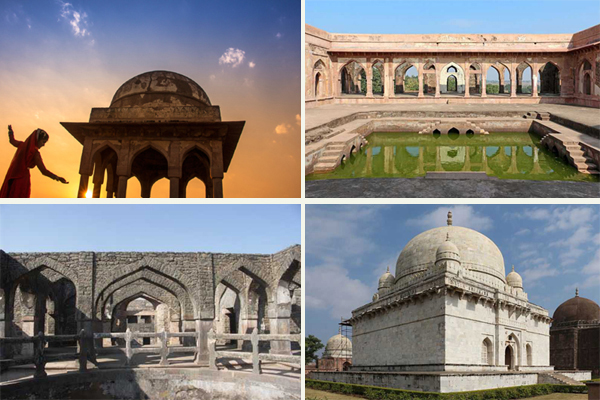
Ashrafi Mahal (literally the “Palace of Gold Coins”) is a 15th-century historical monument located in Mandu, Madhya Pradesh, situated directly opposite the Jami Masjid. Despite its name, it was never built as a royal palace
Situated right in front of the Jami Masjid, the Asharfi Mahal, has been known by many different names on the pages of history. It is said to have been a Sanskrit University during the time of Raja Bhoj in 1024. When Mandav was taken over by the Sultans and Hoshang Shah ascended the throne, he turned it into a Persian University. This was India’s first and world’s fourth Persian University. The students lived upstairs and studied on the ground floor. After Hoshang Shah, Mahmud Shah came into power and during his rule the kingdom of Mandav was at its peak. Before his death, he wanted a grand tomb for himself. The design of this building, therefore, was changed and the courtyard was turned into a tomb. The dome of this tomb, made with black, yellow and white marble, was grander than the Jami Masjid and Hoshang Shah’s tomb. Built in a hurry by inept artisans, the tomb did not withstand the vagaries of time and soon dilapidated. If the tomb wasn’t made with carelessness, today it would have been the most impressive one among the city’s grand buildings.
The beauty of the moon on a full moon night can be seen from this palace’s pavilion. There is a story behind the palace’s name. With every step, the moon rises higher and from the final step the moon it looks like a silver coin through the arched frame and hence the palace was named Asharfi Mahal.
Baz Bahadur’s Palace
Baz Bahadur’s Palace in Mandu, Madhya Pradesh, is a 16th-century structure known for its unique architectural blend and its association with the romantic legend of Sultan Baz Bahadur and singer Rani Roopmati.
Baz Bahadur Palace is one of the prominent tourist attraction at Mandu tourist destination. Its name is derived from Mandu ruler Baz Bahadur who was fond of music and art and was in deep love of his wife Roopmati. During his rule time, Mandu was in it peak. Palace is located on hill slope with scenic surrounding. It is about 95 kms west of Indore city and easily accessible by road. Baz Bahadur palace is a interesting blend of Rajput and Mughal architecture and style. Its name Baz Bahadur has been derived from the name of ruler Baz Bahadur who was fond of music and art. During his rule, Mandu was at its peak. This palace was actually built far before Baz Bahadur came into power. Inscription at the palace entrance gate describes its construction to Sultan Nasiruddin Shah in AD 1508-09.
The main gateway to the palace is approached by 40 broad steps with landings in intervals. The passage through gateway have the rooms for guards which is having vaulted ceiling. This passage have arched designs on both the ends which gives it a artistic look and it leads to the outer court of the palace. This outer court can also be reached by main doorway. On main part of the palace we will find open court which is having beautiful fountain in middle. All four sides have halls and rooms. These halls are used for different purpose like meetings with public, meetings with administrative officers etc. If we look at the north of the Baz Bahadur palace, we will find an octagonal pavilion with arches which overlooks an garden area where marks of history can still be seen. Their are steps that lead to spacious terrace with boundaries which offers a breathtaking view of Roopmati Pavilion in foreground and beautiful countryside view.
Champa Baoli
Champa Baoli is a remarkable 15th-century stepwell located in the ancient city of Mandu. The baoli, built during the reign of the Malwa Sultanate, was designed to store water and provide a cool retreat during the hot summer months. The Hammam, or bath complex, is an adjacent structure featuring a unique system of water channels and underground rooms used for royal baths and relaxation.
Hoshang’s Tomb
Hoshang’s Tomb, located in the ancient city of Mandu, Madhya Pradesh, India, is the final resting place of Hoshang Shah, the first Muslim ruler of the Malwa region. Built in the 15th century, this tomb is considered one of the finest examples of early Indo-Islamic architecture. The tomb features intricate marble carvings, lattice screens, and a beautiful dome, showcasing a blend of Indian and Islamic architectural styles.
Taveli Mahal
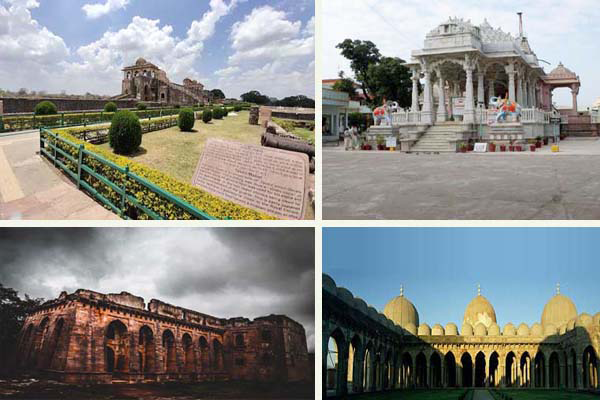
Taveli Mahal, situated in Mandu, Madhya Pradesh, India, is a fascinating historical structure that once served as a stable for the royal elephants and horses during the Malwa Sultanate era. This 15th-century structure features a blend of Islamic and Indian architectural styles, with arches and domes adorning the exterior. Today, Taveli Mahal has been transformed into a museum that displays various artifacts, sculptures, and antiquities from Mandu’s rich past.
Jain Temple
Jain Temple Mandu is a group of beautiful Jain temples located in the ancient city of Mandu, Madhya Pradesh, India. These temples, dating back to the 15th century, are dedicated to various Jain Tirthankaras and showcase intricate carvings, stunning sculptures, and detailed friezes. The temples are an excellent example of the Jain architectural style and serve as a peaceful retreat for devotees and visitors alike.
Hindola Mahal
Hindola Mahal, also known as the ‘Swinging Palace,’ is a fascinating 15th-century structure located in the ancient city of Mandu. Constructed during the reign of Hoshang Shah, the palace is known for its unique sloping walls that resemble a swing, thus giving it its name. The Hindola Mahal showcases an elegant blend of Afghan and Islamic architectural styles, featuring a T-shaped layout, intricate carvings, and impressive arches.
Jami Masjid
Jami Masjid, also known as the Great Mosque of Mandu, is a stunning 15th-century mosque located in the ancient city of Mandu, Madhya Pradesh. Built during the reign of Sultan Hoshang Shah, the mosque showcases a remarkable fusion of Hindu and Islamic architectural styles. Jami Masjid is known for its grand courtyard, intricately carved domes, and beautiful arches that reflect the rich architectural heritage of the region.
Rani Rupmati’s Pavilion
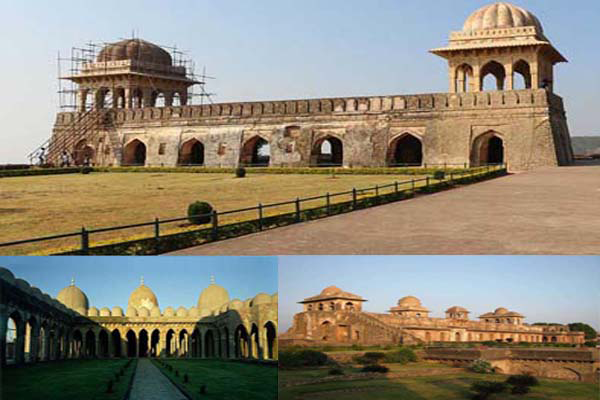
Rani Rupmati’s Pavilion is a beautiful and historically significant monument situated on a hilltop in the ancient city of Mandu, Madhya Pradesh, India. The pavilion was built in the 15th century as a symbol of the love between Sultan Baz Bahadur and Rani Rupmati. The structure is a mesmerizing blend of Afghan and Rajput architecture, consisting of two sandstone pavilions overlooking the Narmada River valley.
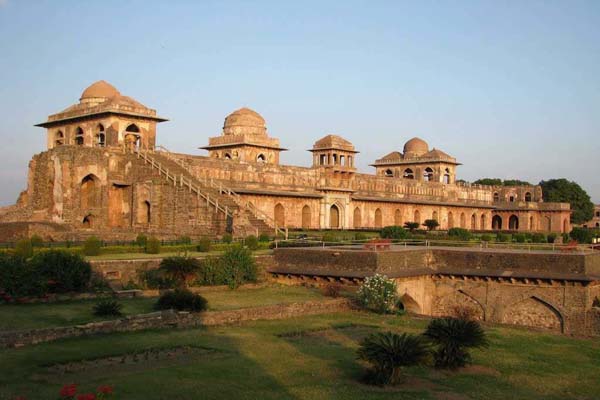
JAHAZ MAHAL – SHIP PALACE
It is among the most unique monuments of India. When you look at the palace, it looks like a beautifully painted picture on Mandav’s canvas. A palace like this cannot be seen anywhere else. Situated between Kapoor and Munj Sagar Talab,it seems like a grand ship anchored in deep seas. On a rainy day, the beauty and artistry here is its prime.This palace is believed to have been built under Ghiyasuddin Khilji in the 15th century for his 15,000 queens. The architecture is apparently inspired by Hindu style.
The height of this building is 121 meters and the width is 15.2 meters. There are three huge rooms on the lower floor with a corridor connecting them.A bathing pool was built nearby for the queens. Behind the rooms, there is a huge pavilion, from here one gets a beautiful view of the Munj Sagar Talab. There is an artistic and beautiful staircase, Inspired by a ship’s stairs, that leads to the upper floor. The building is in the image of a ship. There are big pavilions and rooms on both sides of the first floor. The terrace is 62 meters long and 14 meters wide. Both the floors have Lotus-shaped pools that were filled with the help of Rehat technology. Each pool has a capacity of 30,000 litres. This is the only building in Mandav the walls of which were plastered. While the other buildings in Mandav were made with lime, mortar and stone powder, this building was made by clamping iron and stone.