
Tourist places in Khajuraho
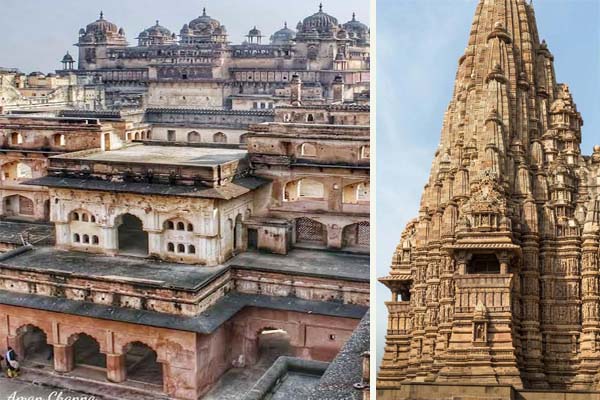
The temples at Khajuraho were built during the Chandella dynasty, which reached its apogee between 950 and 1050. Only about 20 temples remain; they fall into three distinct groups and belong to two different religions – Hinduism and Jainism. They strike a perfect balance between architecture and sculpture. The Temple of Kandariya is decorated with a profusion of sculptures that are among the greatest masterpieces of Indian art.
The temples of Khajuraho are known for the harmonious integration of sculptures with their architecture. All surfaces are profusely carved with anthropomorphic and non-anthropomorphic motifs depicting sacred and secular themes. Sculptures depicting acts of worship, clan and minor deities, and couples in union, all reflect the sacred belief system. Other themes mirror social life through depictions of domestic scenes, teachers and disciples, dancers and musicians, and amorous couples. The composition and finesse achieved by the master craftsmen give the stone surfaces of the Khajuraho temples a rare vibrancy and sensitivity to the warmth of human emotions.
Khajuraho Group of Monuments is owned by the Government of India and managed by the Archaeological Survey of India through the Ancient Monuments and Archaeological Sites and Remains (AMASR) Act (1958) and its Rules (1959), amendment (1992), and Amendment and Validation Act (2010).
Sound and light show
The sound and light spectacle put on by the Western Group of Temples is undoubtedly among the interesting nighttime activities in Khajuraho. It is a ticketed event where people can explore the historical, religious, and cultural aspects. Even though these temples are stunning, the light and sound display puts them in a brand new light.
Lakshmana Temple
In Khajuraho, the Lakshmana Temple is the second largest temple. The temple was built between A.D. 930 and 950. The temple is devoted to Lord Vishnu, a Hindu deity. The sculptures are wonderful and the architecture is stunning. The temple is artistically built, with carvings of Hindu Gods, statues, and sculptures on the temple walls. A temple that is worth a visit, and you will never get tired of admiring this magnificent work of art.
Beni Sagar Dam
An environmental hotspot within a kilometre of the Khajuraho Railway Station is the Beni Sagar Dam, which provides a thrilling and refreshing picnic place for families. This area, which covers 7.7 sq. km, is surrounded by lush greenery and a relaxing atmosphere. Full of calmness and tranquillity, it’s probably the best location to visit to unwind after a long day in the city. Beni Sagar Dam also offers activities like hiking and rowing. Take a nature walk to surrounding trails and then row your boat (or be rowed) around the dam.
Orchha fort
Orchha Fort is an impressive feat of architectural fusion, seamlessly merging Rajput and Mughal styles into an alluring panorama. Every structure within its complex boasts intricate carvings and designs which perfectly encapsulate Orchha’s rich cultural heritage. Boasting towering walls, ornate gateways and mesmerising frescoes within palaces, Orchha Fort stands as a timeless testament to India’s mediaeval glory.
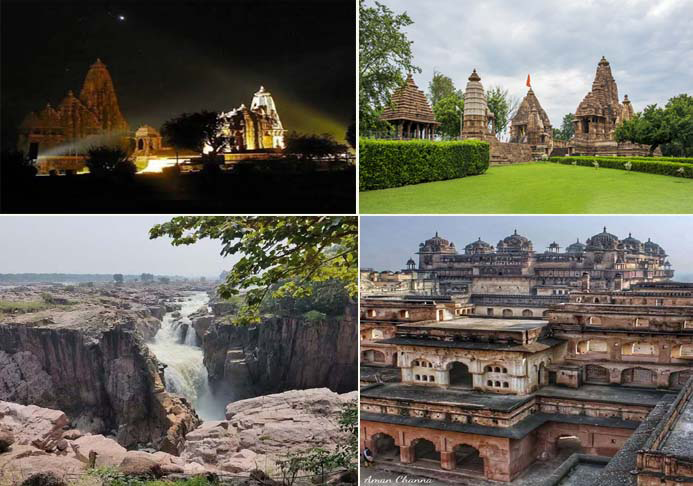
Orchha Fort is steeped in history, standing as the symbol of the Bundela Dynasty. A major centre for political and cultural influence, this fort has played a pivotal role in shaping its surroundings. You can immerse in its fascinating past through a visit to Orchha Fort.
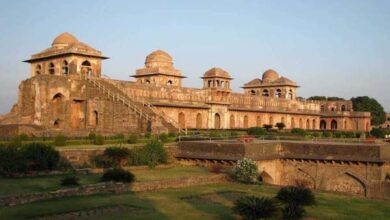
Step inside the stunning Jahangir Mahal of Orchha Fort, created by visionary Bundela King Vir Singh Deo to commemorate Mughal Emperor Jahangir. According to legend, this architectural marvel was assembled overnight, testament to both his artistic brilliance and love for Mughal Emperor Jahangir. Also, within Orchha Fort lies another captivating structure known as Rai Parveen Mahal which was constructed by Bundela King Indramani as a gesture of his affection towards renowned courtesan Rai Parveen whom he considered dear. This palace stands as testament to love’s timeless allure!
Mahadev Temple
. Kandariya Mahadev Temple in Khajuraho, earlier known as Shivalaya, has a glorious past since 999 AD. This temple’s dimensions are 102′ in length, 6′ in width, and 101′ in height. Locals of this region describe that the name Kandariya is also another name for Lord Shiva. And this is how the Kandarpi evolved and came into existence.
King Vidyadhar from the Chandel Dynasty constructed this beautiful Mahadev Temple between 1025- 1050 AD. It is also well-known for the artistic sculptures, and tall designs are known as the ‘Chaturbhuj Temple.’ The jaw-dropping artistry seems like someone has artistically carved an era on the stones of this temple. Kandariya Mahadev Temple also got the position amongst UNESCO World Heritage sites for its stunning carved works and writings in the year 1986.
A Muslim historian Ibn-Al-Athir mentioned the power and galore of King Vidydhar, who constructed the Kandariya Mahadev temple in those times. He also fought with the Mahmud Ghaznavi, following which the Ghaznavi returned. Again he tried to attack his fort in 1022 but failed the attempt. As a symbol of his victory then, Vidyadhar constructed the Kandariya Mahadev temple dedicated to the supreme power, Lord Shiva.
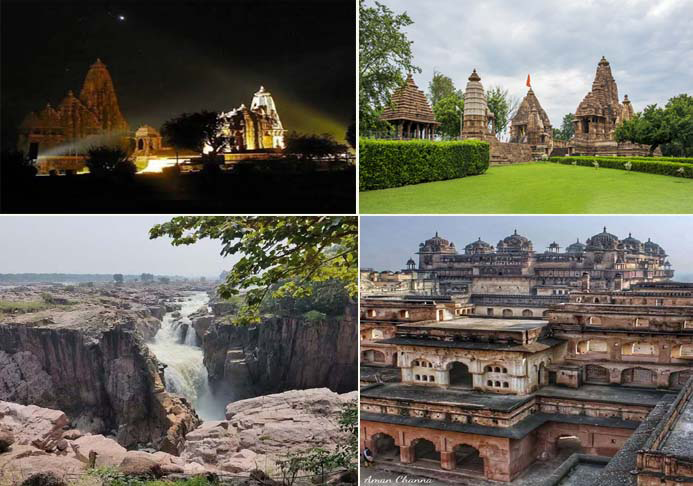
Lakshmana Temple
The Lakshmana Temple is a 10th-century Hindu temple built by Yashovarman during the Chandela dynasty located in Khajuraho, India. It is dedicated to Vaikuntha Vishnu – an aspect of Vishnu. As part of the Khajuraho Group of Monuments, and owing to its architecture and religious importance, the temple was inscribed on the UNESCO World Heritage List in 1986
Matangeshwara Temple
he Matangeshvara temple (IAST: Matangeśvara Mandir) is a Shiva temple in the Khajuraho town of Madhya Pradesh, India. Among the Chandela-era monuments of Khajuraho, it is the only Hindu temple that is still actively used for worship. As part of the Khajuraho Group of Monuments, the temple was inscribed on the UNESCO World Heritage List in 1986 because of its art, architecture, and testimony to the Chandela culture.
The Archaeological Survey of India (ASI) assigns the Matangeshvara temple to 900-925 CE, because it has a plain design unlike the later temples of Khajuraho. However, scholar Rana P. B. Singh assigned it to approximately 1000 CE.
The temple has been classified as a Monument of National Importance by the ASI.
According to the history, a sage named Matanga manifested in form of a lingam, and controlled the god of love. His hermitages were located at Khajuraho, Kedarnath, Varanasi and Gaya. These are now the sites of four Matangeshvara (“Lord of Matanga”) temples. Another account states that the temple is named after an aspect of Shiva who controlled the god of love.
Art and architecture
The Matangeshvara temple is a larger-scale version of the Brahma temple in terms of plan and design.[2] It has a square plan. It houses a 2.5 m high lingam, which is 1.1 m in diameter. The base platform of the lingam is 1.2 m high and 7.6 m in diameter.[6] The lingam has Nagari and Persian inscriptions.
Chitragupta Temple
The Chitragupta temple is an 11th century temple of Surya (sun god) in the Khajuraho town of Madhya Pradesh, India. Architecturally, it is very similar to the nearby Jagadambi temple. The temple is a part of the Khajuraho Group of Monuments, a World Heritage Site.
History
Based on the epigraphic evidence, the temple’s construction can be dated to 1020-1025 CE. It was probably consecrated on 23 February 1023 CE, on the occasion of Shivaratri.
The temple has been classified as a Monument of National Importance by the Archaeological Survey of India.
Architecture
The Chitragupta temple is very similar to the nearby Jagadambi temple. It has a sanctum with a circumambulatory path, a vestibule, a maha-mandapa (large hall) with transepts, and an entrance porch. The large hall has an octagonal ceiling, which is more ornate than the corresponding ceiling in the Jagadambi temple. This suggests that the Chitragupta temple was constructed slightly later than the Jagadambi temple.[3] The building has two balconies, and the ascending scale of the roof is not as impressive as that of the more prominent temples in Khajuraho.
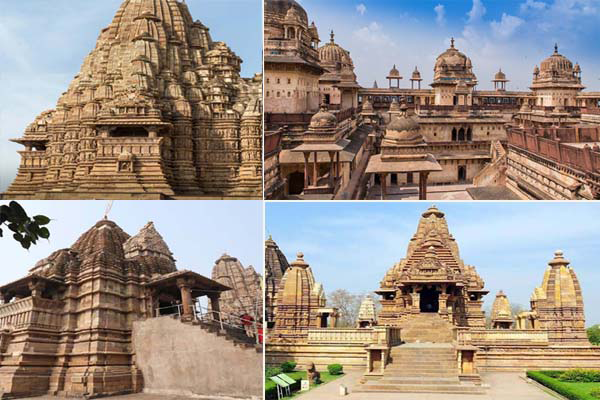
Devi Jagdamba Temple
Devi Jagadambika Temple or Jagadambika Temple is one of a group of about 25 temples at Khajuraho, Madhya Pradesh, India. Along with the other temples at Khajuraho, the temple was listed as a World Heritage Site because of its outstanding architecture, art, and historical importance The temples of Khajuraho were built by the rulers of the Chandela dynasty between the 10th and the 12th centuries.
Devi Jagadambika temple, in a group to the north, is one of the most finely decorated temples at Khajuraho. It is named after Jagadambika, a Hindu goddess related to devi. Three bands of carvings encircle the body of the temple. In the sanctum is an enormous image of the Goddess (Parvati)
The Devi Jagadambi Temple is one of the Khajuraho group of monuments that were built during the rule of the Chandela dynasty. The building activity started almost immediately after the rise of their power, throughout their kingdom to be later known as Bundelkhand. Most temples were built during the reigns of the Hindu kings Yashovarman and Dhanga. Yashovarman’s legacy is best exhibited by the Lakshmana Temple. Vishvanatha temple best highlights King Dhanga’s reign.The largest and currently most famous surviving temple is Kandariya Mahadeva built in the reign of King Vidyadhara.The temple inscriptions suggest many of the currently surviving temples were complete between 970 and 1030 CE, with further temples completed during the following decades.
Chausath Yogini Temple
The Chausath Yogini Temple in Khajuraho, Madhya Pradesh, is the oldest surviving temple in the region, dating back to approximately 885 CE (late 9th century). It belongs to the pre-Chandela period or early Chandela rule
The Chausath Yogini temple is a ruined Yogini temple in the Khajuraho town of Madhya Pradesh, India. Dated to the late 9th century, it is the oldest surviving temple at Khajuraho. Unlike the Yogini temples at other places, it has a rectangular plan, but like them it is hypaethral, open to the air. As part of the Khajuraho Group of Monuments, and because of its unique Chandela architecture, the temple was inscribed on the UNESCO World Heritage List in 1986.
History
The construction of the Khajuraho Yogini temple can be dated to approximately 885 CE It is the earliest extant temple at the Chandela capital, Khajuraho.[3] The temple has been classified as a Monument of National Importance by the Archaeological Survey of India.
Ruins of Yogini temples have been found at other places in and around the territory formerly ruled by the Chandelas or their feudatories, including Badoh, Bhedaghat Dudahi, Lokhari, Hinglajgarh, Mitaoli, Nareshwar, and Rikhiyan. This suggests that the cult of the Yoginis was well-established in the Chandela territory. The Chausath Yogini temples are connected to the Kapalika and Kaula sects.
Parsvanath Temple
The Parsvanath Temple is the largest and finest Jain temple in the Eastern Group of Monuments at Khajuraho, Madhya Pradesh
Parshvanatha temple is a 10th-century Digambara Jain temple at Khajuraho in Madhya Pradesh, India. It is now dedicated to Parshvanatha, although it was probably built as an Adinatha shrine during the Chandela period. Despite the temple’s Jain affiliation, its exterior walls feature Vaishnavaite themes. The entrance has an inscription with a most-perfect magic square. It is part of a UNESCO World Heritage Site along with other temples in the Khajuraho Group of Monuments, because of its outstanding art, architecture, and testimony of the Chandela period.
History
The temple is believed to have been constructed by a prominent Jain family between 950 and 970 CE, during the reign of the Chandela king Dhanga. A 954 CE (1011 VS) inscription on the left door jamb of the temple records gifts and endowments of gardens by one Pahila. The gardens are named Pahila-vatika, Chandra-vatika, Laghuchandra-vatika, Shankara-vatika, Panchaitala-vatika, Amra-vatika and Dhanga-vadi. The inscription describes Pahila as a devotee of Jinanatha and states that he was held in great esteem by the king Dhanga.
The earliest idol enshrined in the temple appears to have been that of Adinatha. When the British archaeological surveyor Alexander Cunningham visited in 1852, he found the main sanctum deserted. He described it as “Jinanatha temple” and wrote that it had been repaired by a Jain banker in 1847. In 1860, a Parshvanatha idol was installed in the main sanctum. An Adinatha statue was placed in a secondary shrine attached to the rear of the temple.
The temple has been classified as a Monument of National Importance by the Archaeological Survey of India.
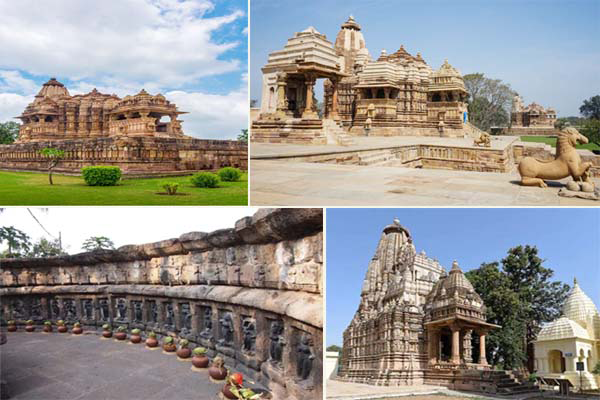
Adinath Temple
The Adinatha Temple in Khajuraho, Madhya Pradesh, is a historic shrine dedicated to Adinatha, the first Jain Tirthankara.
Adinatha temple (IAST: Ādinātha Mandir) is a Digambara Jain temple located at Khajuraho in Madhya Pradesh, India. It is dedicated to Adinatha, although its exterior walls also feature Hindu deities. This particular temple was originally built as a Hindu temple before being subsequently made into a Jain temple.This temple is part of UNESCO World Heritage Site along with other temples in Khajuraho Group of Monuments.
History
The Adinatha temple is dated to the late 11th century CE. It was probably constructed slightly later than the Vamana temple. The architectural features of the Pārśvanātha and Adinātha temples exhibit significant evidence suggesting that these structures were initially constructed as Hindu temples before being subsequently adopted by the Jain community in the 13th century.
In the garbhgraha, there is a black schist (or basalt) statue of Lord Adinath with a three line inscription. It gives the date (samvat 1215 (1158 AD). It gives the name of the donor as Kumarnandi and the sculptor as Ramaveva. It mention that Kumarnandi was the disciple of Bhanukirti, who was disciple of Rajanandi, who was disciple of Ramachandra of Mula Sangha. The inscription includes 3 shardulavikridita verses in literary Sanskrit.
Shantinath Temple
Shantinatha temple (IAST: Śāntinātha Mandir) is a Digambara Jain temple located among the Jain temple cluster in eastern Khajuraho in Madhya Pradesh, India. While its main deity is the Jain tirthankara Shantinatha, it includes 18 shrines with numerous Jain images.
The temple has been classified as a Monument of National Importance by the Archaeological Survey of India. This temple is part of UNESCO World Heritage Site along with other temples in Khajuraho Group of Monuments, listed for their testimony to the Chandela dynasty and their outstanding art and architecture.
History
The temple incorporates two Chandella period shrines, along with fragment of other Chandella period temples. The present structure may have been constructed in 1870 CE, when a Gajarath festival was organized by Kanchhedtilal Jain of Nagaur marking a renewal of the site accompanied by installations of new images, as indicated by the inscriptions.
The pedestal of the 12 foot Shantinath image in the Shantinatha temple bears an inscription dated Samvat 1085 (1027-28 CE) mentioning the installation by Chandradeva, the son of Thakur Devadhar. The inscription is now hidden under plaster. The original Shantinatha temple has been incorporated the 19th century structure, and is now the main centre of Jain worship in Khajuraho.
Architecture
Although the present-day temple structure features modern renovations, the nucleus of the temple is quite old. It features an oblong enclosure of shrine cells depicting the older sculptures.The temple has a courtyard. Two sides of the structure incorporate Chandella period structures. The temple and the images installed thus span 10 centuries.
The present structure is a quadrangle, as many Jain temples of the nineteenth century are, with an open courtyard in the middle. The older stone structure and elements are clearly seen embedded in the 19th century masonry structure.
Shrine 1 in the center contains the ancient Shantinath image which is flanked by smaller images of all the 24 tirthankara. The doorway includes the conventional images of goddess Ganga and Yamuna, and there is notable image of the guardian deity Kshetrapala. The 18 shrines house numerous 11/12th century and 19th/20th century images. Some of the ancient images were brought here from ruined Jain temples in Fatehpur (near Hatta in damoh dist) and Bilahri in Katni district. One of the wings of the quadrangle serves as a gallery displaying historical photographs and prints from early 2oth century.
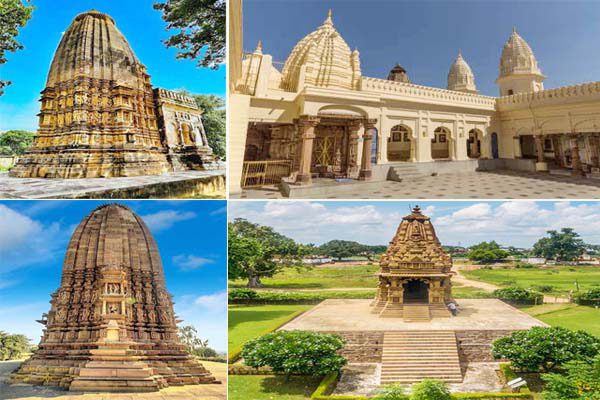
Vamana temple
Vamana temple (Devanagri:वामन मंदिर) is a Hindu temple dedicated to Vamana, an avatar of the god Vishnu. The temple was built between 1050 and 1075.
Location
The temple is located in the eastern area of Khajuraho It is situated about 200 meters to the north-east to Brahma Temple.
Architecture
It has a sanctum, vestibule,maha-mandapa with lateral transepts and an entrance-porch.
Javari Temple
The Javari Temple is a Hindu temple located in the Eastern Group of Temples in Khajuraho, Chhatarpur district, Madhya Pradesh, India, and is part of the Khajuraho Group of Monuments UNESCO World Heritage Sit
The temple is dedicated to the Hindu deity Shiva.The main idol of the temple is broken and headless(see image).
Location
The temple is located in the eastern area of Khajuraho. It is near to and visible from Vamana Temple, and at a distance of about 200 meters (south) from it.
Architecture
It has well-proportioned architecture, with a sanctum, vestibule, mandapa and portico, but without pradakshinapatha. It has remable Makara Torana(Capricorn Arch) and shikhara (top). It has three bands of carved sculptures on the outer wall. The temple has a close resemblance with Chaturbhuja Temple, also at Khajuraho.
Ghantai Temple
Ghantai Temple in Khajuraho is a ruined 10th-century Digambara Jain temple located in the Eastern Group of Monuments.The Ghantai temple, also known as the Ghanti temple, is a ruined Digambara Jain temple in the Khajuraho town of Madhya Pradesh, India. Similar in style to the Parshvanatha temple, it was dedicated to the Jain tirthankara Rishabhanatha (also known as Adinatha). This temple is part of the UNESCO World Heritage Site along with other temples in Khajuraho Group of Monuments.
History
The construction of the Ghantai temple can be dated to approximately 995 CE,during the reign of the Chandela king Dhanga. It is similar to the Parshvanatha temple, but has a much larger scale, which indicates that it was constructed after the Parshvanatha temple.
When Alexander Cunningham surveyed the temple ruins in the 19th century, he assumed it to be a Buddhist shrine because of a Buddha statue found near the site. However, later studies have established it to be a Jain temple.
Dulhadev Temple
The Dulhadev Temple (also known as Duladeo or Kunwar Math) is a Hindu temple dedicated to Lord Shiva, located in the southern group of monuments in Khajuraho, Madhya Pradesh
The Duladeo Temple (Devanagri: दुलादेव मंदिर) is a Hindu temple in Khajuraho, Madhya Pradesh, India. The temple is dedicated to the god Shiva in the form of a linga, which is deified in the sanctum. ‘Dulodeo’ means “Holy Bridegroom”. The temple is also known as “Kunwar Math”. The temple faces east and is dated to 1000–1150 AD.It is the last of the temples built during the Chandela period. The temple is laid in the seven chariot plan (saptarata). The figurines carved in the temple have soft expressive features unlike other temples. The walls have a display of carved celestial dancers (apsara) in erotic postures and other figures. As part of the Khajuraho Group of Monuments, the temple was inscribed on the UNESCO World Heritage List in 1986.
Location
The temple is located on the bank of the Khodar River in the southern group of the Khajuraho Group of temples in Khajuraho village in an area spread over 6 square kilometres (2.3 sq mi). It is 5 kilometres (3.1 mi) away from the Khajuraho village close to the Jain enclosure.The approach road is rough.
History
A 19th century artist’s depiction of king Kirttivarman visit to the temple in the 11th century CE.Duladeo Temple is one of the 22 temples to the Hindu god Shiva, which are among the 87 temples that were created by the Chandela rulers of Central India. The peak period of building activity was from 950 to 1050 AD in the small village of Khajuraho. The temples belong to the traditional religions of Hinduism and Jainism. They are identified under three groups or three zones – the western zone, the eastern zone and the southern zone. Ibn Batuta, the Moroccan traveller had attested to the existence of these temples even in 1335. The temples in the southern group are the Duladeo and Chaturbhujs. All the extant temples were inscribed in 1986 under the UNESCO List of World Heritage Sites under Criterion III for its artistic creation and under Criterion V for the culture of the Chandellas that was popular till the country was invaded by Muslims in 1202. It is also said that Madanaverman (1128–1165) of the Chandela dynasty built this temple during his reign.
The sculptures in the temple have strong identity with those found among the remnants of a temple in Jamsor near Kanpur in Uttar Pradesh. From this similarity it has been inferred that the sculpturing at both locations were the handiwork of the same sculptors and further that they were created during the period from 1060 to 1100, during the reign of Kirttivarman. However, Archaeological Survey of India has inferred the period of temple building activity in Khajuraho from 950 to 1150 AD based on palaeography and the architectural style.
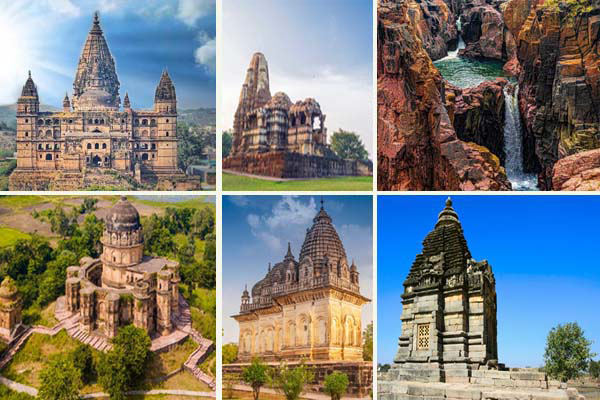
Chaturbhuja Temple
The Chaturbhuj Temple (also known as the Jatakari Temple) is a notable historical monument located near Jatakari village in the Southern Group of temples in Khajuraho, Madhya Pradesh, India.
Chaturbhuj Temple (Devanagari: चतुर्भुज मंदिर) is a temple dedicated to the Hindu god shiva in Khajuraho, India in the village of Jatakari. It is also known as Jatakari Temple (Devanagari: जटकारी).
The name Chaturbhuja (lit. “One who has four arms”) is an epithet of Vishnu. The temple was built by Yasovarman of the Chandela Dynasty in c. 1100 CE. This is the only temple in Khajuraho which lacks erotic sculptures.
As part of the Khajuraho Group of Monuments, the temple was inscribed on the UNESCO World Heritage List in 1986 because of its architecture and testimony to the Chandela dynasty
Raneh Falls
The Raneh Falls is a natural waterfall on the Ken River, located in Khajuraho in the Indian state of Madhya Pradesh.
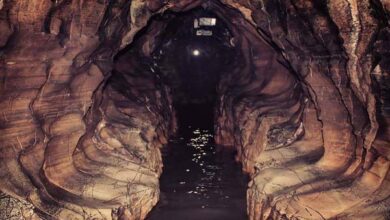
The Ken River forms a 5 kilometres (3.1 mi) long, and 30 metres (98 ft) deep canyon made of pure crystalline granite in varying shades of colours ranging from pink and red to grey. There is a series of waterfalls in the canyon. The larger and smaller falls run all through the year. Other seasonal falls appear during monsoons.
It is about 20 kilometres (12 mi) away from Khajuraho. The Ken Gharial Sanctuary is located at the confluence of the Ken and Khudar rivers further down from Reneh Falls.The Ken river here runs through a narrow gorge of igneous rocks rich in Granite and Dolomite. The Pandav Falls in Panna National Park is also located nearby.
Maharaja Chhatrasal Museum
Maharaja Chhatrasal Museum is a museum located in an old palace at Dhubela, on the Chhatarpur-Jhansi highway, in Chhatarpur District, Madhya Pradesh, India. This museum was established in September, 1955 in a palace built by Chhatrasal for his residence. Presently, the museum comprises 8 galleries, of which two galleries display inscriptions, copper plates, Sati pillars, lingas and inscribed images of the Gupta and Kalachuri period. The museum houses a wide range of sculptures of the Shakti cult. It also has a significant collection of Jaina images. It also displays the garments, weapons and paintings of the Bundela kings.
The Dhubela Museum is located at Dhubela on the Chhatarpur-Nowgaon highway, 15 km from Chhatarpur and 62 km from Khajuraho. This place can be reached from Khajuraho by road.
Maharaja Chhatrasal (4 May 1649 – 19 December 1731), was a medieval Indian warrior who fought against the Mughal Emperor Aurangzeb, and established his own kingdom in Bundelkhand, becoming a Maharaja. Maharaja Chhatrasal Maqbara is one of those historical monuments of Chhatarpur that is actually the cenotaph of the Maharaja of Chhatrasal. It is also an important monument from an architectural point of view.[citation needed] This beautiful example of Bundeli architecture was built by Baji Rao Peshawa (First) in memory of Maharaja Chhatrasal in 1736 A. D
Parvati Temple, Khajuraho
Parvati Temple is a temple dedicated to the goddess Parvati,consort of Shiva.It has heavily restored small sanctum. The porch is completely lost and of the sanctum only the plinth has survived.
The arch above sanctum door depicts sculpture of Brahma, Vishnu and Shiva. Also numerous erotic sculptures of couples can be seen on the front wall (on the side of sanctum door.
The side and back walls do not have any sculptures
Brahma temple
Brahma Temple is a ninth or early tenth century temple and is located at Chhatarpur in Madhya Pradesh, India. Although titled after the Hindu god Brahma, the temple is dedicated to Shiva. This temple, along with many others built during the Chandela dynasty, form the UNESCO World Heritage Site of Khajuraho Group of Monuments.
The temple is located on the banks of Khajuraho Sagar lake. It is incorrectly called Brahma Temple; the garbhagriha (sanctum) of the temple contains a four faced lingam, the symbol of Shiva, and local worshippers mistook this for a sculpture of Brahma, who has four faces.The western windows and the central positions of the lintels of the garbhagriha contain figures of Vishnu. However, the stones from which they are made are different from the stones which are used to build the temple.
The temple was built in either ninth and earlier half of the tenth century.
The Brahma temple is one of the various surviving temples in the Khajuraho temple complex. Unlike most of the other temples, which are made of grainstone, this temple is made of granite. The plan of this temple is similar to that of the Lalguan Mahadeva temple. These temples were built during a period in which a transition was occurring from granite to sandstone.
According to the Archaeological Survey of India, the plan of this temple is simpler compared to the other temples of Khajuraho. The shikhara (the tower over the chamber in which the deity is kept) is made of sandstone. The temple originally consisted of a porch and a garbhagriha. The porch has been destroyed and only the garbhagriha remains which is crowned by the shikhara. Externally, the garbhagriha is cruciform in shape and contains projections in each side. Internally, it is square in shape and rests on 12 pilasters of granite. The eastern projection contains the main doorway, and the western projection contains a smaller doorway. Latticed windows are present on the remaining two lateral projections.
Contact for any help
1-District Magistrate-
2-Locl MLA-
3-Local tourist guide-