
Tourist place in Panna District of Madhya Pradesh
Panna district was created in 1950, shortly after Indian independence, from the territory of several former princely states of British India, including the states of Panna, Jaso, most of Ajaigarh, and a portion of Paldeo. Panna District was part of the new Indian state of Vindhya Pradesh, which was merged into Madhya Pradesh on 1 November 1956.
Panna district is famous for its diamond mines located in a belt of about 80 km across the Panna town.[2] In olden days the most productive mines were located in the village of Sukariuh. Nowadays, Majhagaon is the only active diamond mine in Asia
Panna National Park
Panna National Park is a national park in Panna and Chhatarpur Districts in the Indian state of Madhya Pradesh with an area of 542.67 km2 (209.53 sq mi). It was declared in 1994 as the twenty second Tiger reserve of India and the fifth in Madhya Pradesh.[1] Panna National Park was given the Award of Excellence in 2007 as the best maintained national park of India by the Ministry of Tourism of India.[1] Although the reserve went through an ordeal losing almost all of its tigers in 2009 to poaching, a subsequent recovery program touted as one of the most successful big cat population restorations, has resulted in a growth of up to 80 tigers within the park.
The forests of Panna National Park along with Ken Gharial Sanctuary and adjoining territorial divisions form a significant part of the drainage basin of the 406 km (252 mi) long Ken River, which runs northeast for about 72 km (45 mi) through the national park.
Panna National Park and the surrounding forest area of North and South Panna forest divisions are the only large chunk of wildlife habitat remaining in northern Madhya Pradesh. It is situated at a point where the continuity of the tropical and subtropical dry broadleaf forests belt is broken, and beyond this, the Upper Gangetic Plains moist deciduous forests of the great Indo-Gangetic Plain begin. This area is the northernmost tip of the natural teak forests and the easternmost tip of the natural ‘Kardhai’ Anogeissus pendula forests
Among the animals found here are the Bengal tiger, Indian leopard, chital, chinkara, nilgai, Sambar deer and sloth bear, rusty-spotted cat, Asian palm civet. The park is home to more than 200 species of birds including the bar-headed goose, crested honey buzzard, red-headed vulture, plum-headed parakeet, changeable hawk-eagle and Indian vulture
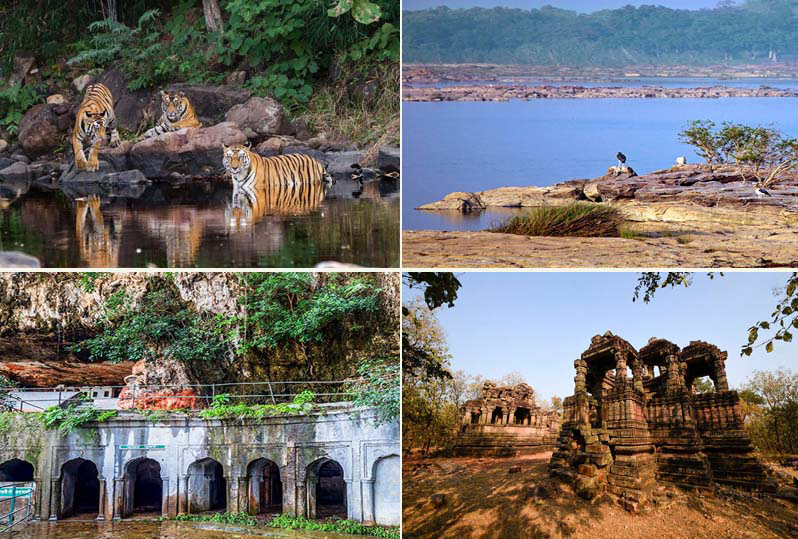
Pandav Falls and Caves
Pandav Falls and Caves are located about 34–35 km from Khajuraho inside the buffer zone of the Panna Tiger Reserve in Madhya Pradesh. The site combines ancient epic mythology with modern Indian histor
The Pandav Falls is a waterfall in the Panna district in the Indian state of Madhya Pradesh.
Ajaygarh Fort
The fort of Ajaigarh is located 80 km from Khajuraho. Ajaigarh Fort, perched on a picturesque hill at a height of 688 m, was a citadel of the Chandela Kings and one of their most important monuments. The fort is bordered by the picturesque Vindhya Ranges, which provide spectacular views of the surrounding countryside. The forts served as a stronghold for the Chandela Kings during their rule.
Majhagaon Diamond Mines
The Diamond Mining Project at Majhgawan – Panna commenced production of diamond in 1971-72. The Majhgawan Diamond Pipe is located at about 15 km from the Panna town in the south-west direction. This project happens to be the only mechanized diamond mine in the country. The Project is equipped with the facilities of Ore Processing Plant including heavy media separation unit, X-ray sorter for diamond separation and disposal system for tailings generated.
It is believed that when Maharaja Chhatrasal was going to battle the Mughals, he was given a boon by a man he idolised.
Raneh Falls
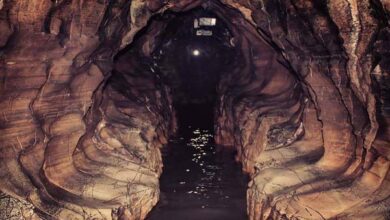
Also known as the Grand Canyon of India, the Raneh Falls is a natural waterfall along the Ken River. The Ken River carves a five km long, 30 m deep canyon of pure crystalline granite, displaying hues from pink and red to grey. This canyon hosts a series of waterfalls, with larger and smaller falls flowing throughout the year, and additional seasonal falls during the monsoons.
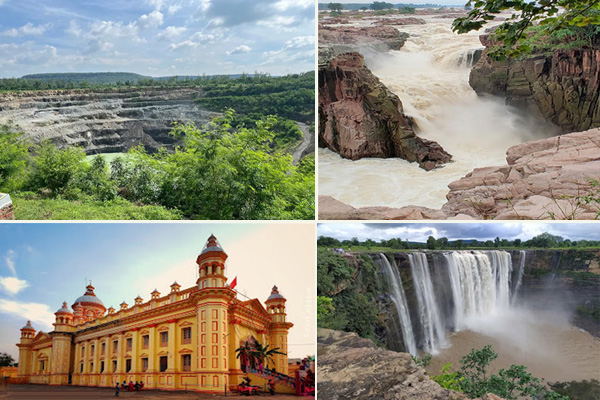
Baldeoji Temple
- Commissioning: The temple was commissioned during the reign of Maharaja Rudra Pratap Singh Bundela of Panna. While sources cite construction beginning around Samvat 1933 (approximately 1876 or the 1930s depending on local calendar traditions, with general historical records placing its build span in the late 19th to early 20th century).
- Design & Architecture: It was designed and executed under the guidance of a European/Italian state engineer (referred to variously as Mr. Manley or Metley).
- The Cathedral Inspiration: The structure is famously built as a scaled-down, Palladian- and Roman/Gothic-inspired replica of St. Paul’s Cathedral in London. This fusion of European church architecture with a Hindu sacred space reflects the cosmopolitan and distinct cultural environment cultivated in Panna
Brihaspati Kund
Brihaspati Kund is a natural water crater, rock-cut gorge, and waterfall system located near Pahari Kheda village in the Panna district of Madhya Pradesh, India (in the Bundelkhand region). It lies roughly 38–40 km from Panna city and south of the historic Kalinjar Fort.
- Guru Brihaspati: The site derives its name from Devguru Brihaspati (the preceptor of the gods). According to Hindu mythology, he established an ashram here and performed intense penance and Yagyas. Legend holds that the gods blessed the surrounding landscape with wealth, which local tradition links to the region’s diamond deposits.
- Lord Rama’s Exile: It is believed that Lord Rama, Sita, and Lakshmana visited this forested Baghein River valley to meet sages and rishis during their exile (Vanvas)
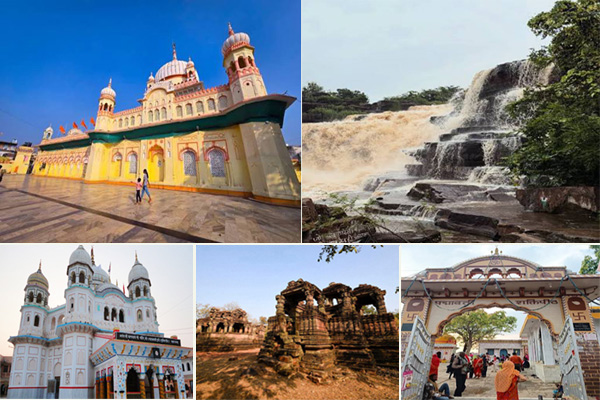
- Jugal Kishor Ji Temple
The Shri Jugal Kishore Ji Temple in Panna, Madhya Pradesh, is a prominent 18th-century Hindu shrine dedicated to Lord Krishna (Jugal Kishore).
- Builder: The temple was built by Raja Hindupat Singh, the fourth Bundela King of Panna, during his reign from 1758 to 1778.
- Origin of the Idol: According to local tradition and legends, the sacred idol originally came from Vrindavan (where it was historically linked to the saint Hariram Vyas in Kishorevan) and was brought to the region through Orchha. Like several other prominent Krishna deities of Vrindavan during the turbulent iconoclasm of the era, the image found a safe haven under the patronage of the Bundela kings.
Kil Kila Waterfall & Kahuaseha Falls
Panna District in Madhya Pradesh traces its roots back to ancient texts like the Valmiki Ramayana (where it is mentioned as Kilkila-Khand) and the Puranas (as Padmawati-Puri). Originally a Gond settlement up to the 13th century, it later became a prominent Bundela Rajput stronghold established as a capital by Raja Chhatrasal Bundela in 1680
Mahamati Prannathji Temple
The Mahamati Prannathji Temple (also known as Shri 108 Prannath Ji Mandir or Padmavatipuri Dham) in Panna, Madhya Pradesh, is the supreme pilgrimage center for the Pranami (Nijanand) Sampradaya.
Arrival of Mahamati Prannathji: Mahamati Prannathji (Mehrāj Ṭhākur) arrived in Panna in the late 17th century (around 1683–1685 CE) at the invitation of the Bundela ruler, Maharaja Chhatrasal, whom he guided spiritually and politically.
Mahamati Prannathji lived in Panna for about 11 years, preaching unity between Hinduism and Islam, teaching universal love, and imparting the Tartam Sagar scripture. He took samadhi (entered final liberation) inside the temple complex around 1694 CE.
The main temple complex was established and built around 1692 CE during his association with Maharaja Chhatrasal.
Padmavati Devi Temple
The Padmavati Devi Temple (also known as the Badi Devi Temple) in Panna, Madhya Pradesh, is a historic and sacred shrine that gives the city of Panna its ancient name.
Shaktipeeth Belief: Local tradition and temple priests note that the shrine is considered a Shaktipeeth—the site where the right foot of Goddess Sati is believed to have fallen.
Gond Dynasty Construction: The present structure of the temple dates back to around Samvat 1321 (approx. 1264 CE) during the rule of the Gond kings, with King Sathya Singh (or Satya Singh) credited with building the original shrine. Over the centuries, it was expanded into a larger temple complex.
============
Contact for any help
1-District Magistrate-
2-Locl MLA-
3-Local tourist guide-
=====================